
 Unsplash (verify the individual image licence and attribution requirements before publication).
AI in Education: Personalisation, Assessment and the Teacher’s Role
Artificial intelligence is moving from an experimental classroom topic to an everyday concern for schools, universities, families and employers. Students may use a chatbot to explain algebra; a teacher may use one to draft differentiated practice; a professional may ask an AI assistant to rehearse a new skill. The opportunity is meaningful personalisation, but the risks are equally practical: inaccurate answers, exposed personal data, hidden bias and work that looks finished without demonstrating learning. The central question is therefore not whether education will use AI, but how people will use it without outsourcing judgement.
Personalisation: useful support, not an automatic tutor
AI systems can respond quickly to a learner’s question, generate examples at different levels and offer alternative explanations. A Year 8 student struggling with fractions might ask for a visual explanation, then practise with fresh problems. A language learner could receive conversation practice outside class. A teacher could use a planning tool to produce three versions of a reading task and then adapt them for the actual pupils in the room. These are plausible classroom uses, not proof that every AI product improves attainment.
UNESCO’s guidance says educational use should be human-centred, age-appropriate and designed around ethical validation, with privacy protection as a core requirement [1]. In practical terms, a student should not paste identifiable records, health information or a classmate’s work into an unapproved service. Schools also need to ask whether a tool works for learners with disabilities, supports the languages being taught and gives teachers enough visibility to correct errors.
Implication for ordinary users: treat an AI explanation as a starting point. Ask it to show steps, check the answer against a textbook or teacher, and report uncertainty rather than accepting fluent prose as evidence of truth. Personalisation is valuable when it increases practice and feedback; it is counterproductive when it replaces the struggle needed to build understanding.
Assessment is shifting from the finished answer to the learning process
Generative AI can produce an essay, solve a routine calculation or suggest computer code. That makes a polished final product a weaker signal of what a learner independently knows. UNESCO’s 2025 assessment analysis argues for greater emphasis on critical thinking, creative problem-solving and ethical reasoning, and describes process evidence, dialogue and defence as ways to reveal intellectual ownership [3]. It also cautions that AI-detection tools can misidentify human writing and miss sophisticated generated work [3].
A concrete redesign might ask students to submit a research question, source notes, an early draft, revision decisions and a short oral explanation. In a history class, students could critique an AI-generated account by checking its claims against primary sources and identifying omissions or bias. In computing, they might use an assistant to propose code, then explain the tests, errors and design choices. The goal is not to pretend AI does not exist; it is to assess whether the learner can question, improve and responsibly use it.
This approach has a cost: teachers need time to design richer tasks and to hold conversations about student reasoning. It can also make assessment more authentic for workplaces, where people routinely research, collaborate, revise and defend decisions. Forecast, clearly labelled: as AI becomes more capable, education is likely to place more weight on demonstrations, portfolios and contextualised projects rather than relying only on take-home text. The direction is an implication of current assessment pressures, not a guaranteed universal policy.
The teacher’s role becomes more important, not less
UNESCO’s AI Competency Framework for Teachers defines 15 competencies across five dimensions: a human-centred mindset, ethics, AI foundations and applications, AI pedagogy, and AI for professional learning [2]. Its progression levels—Acquire, Deepen and Create—underline that teachers need more than button-clicking skills. They need to judge when a tool is appropriate, explain its limits, protect learners and connect technology to sound pedagogy.
The evidence shows why that preparation matters. RAND’s nationally representative 2025 survey found that 54% of students and 53% of surveyed English, mathematics and science teachers used AI for school in 2025. Yet more than 80% of students said teachers had not explicitly taught them how to use AI for schoolwork; only 35% of district leaders reported providing student AI training, and 45% of principals reported having school or district AI guidance [4]. Half of students worried about being falsely accused of cheating.
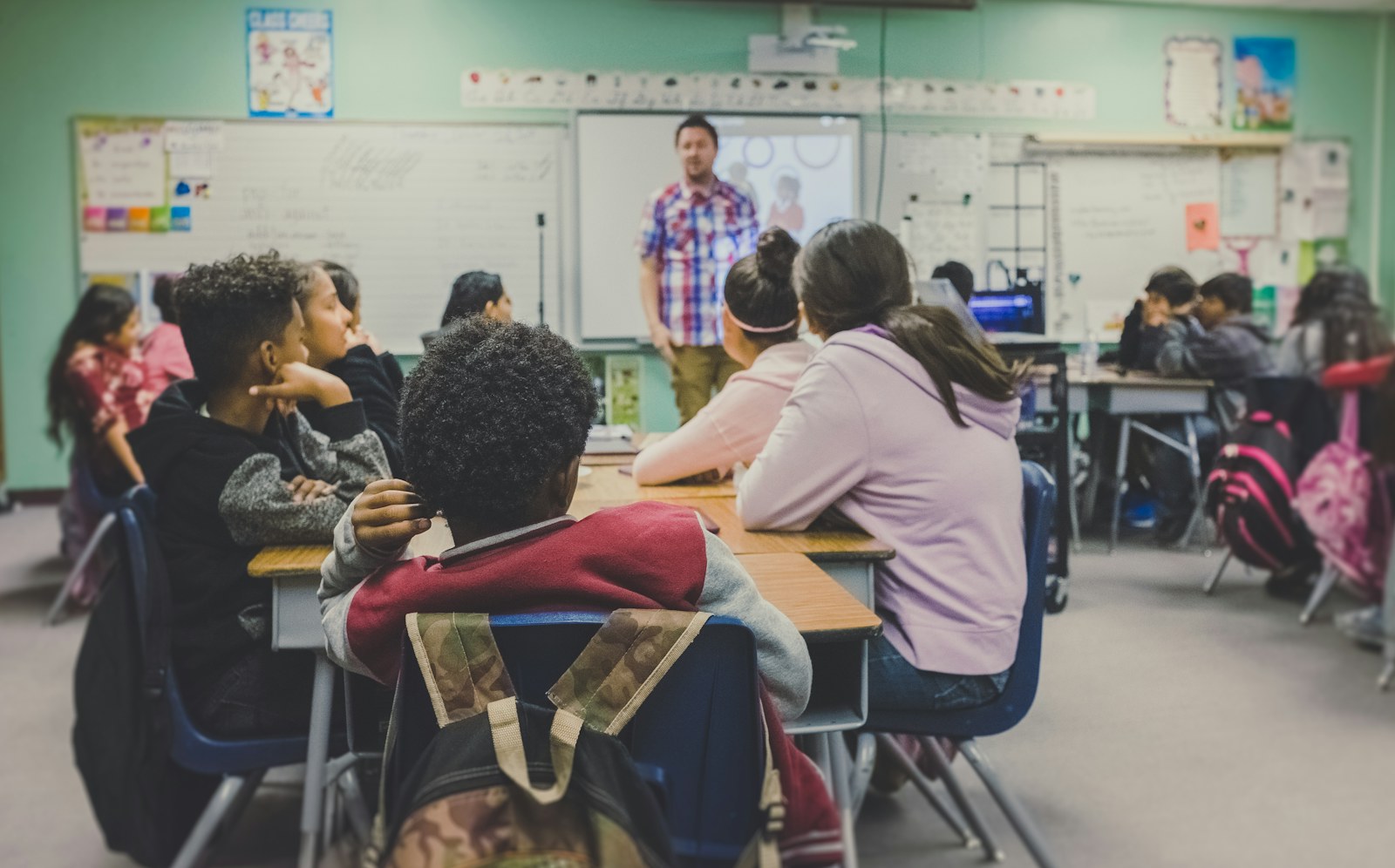
A teacher therefore acts as editor, safety officer, coach and ultimately accountable decision-maker. AI may suggest a lesson or flag a possible misconception, but the educator knows the class context, can notice distress, and can decide whether a generated answer is culturally or academically appropriate. In higher education and professional training, the same principle applies: mentors should teach verification, attribution, data handling and disclosure of AI assistance—not merely ban or permit a tool.
What students and professionals should do now
Students should learn an explicit “verify, revise, disclose” routine: verify facts and citations, revise outputs in their own reasoning and voice, and disclose permitted AI assistance. They should keep drafts and prompts where a course requires evidence of process. Families can ask schools what tools are approved, what data is retained and how allegations of AI misuse are investigated.
Professionals using AI for continuing education should check employer and sector rules, avoid confidential information and use authoritative sources for high-stakes decisions. A nurse, teacher, lawyer or engineer may use AI to generate questions or explanations, but professional responsibility remains with the human who signs off the work.
Conclusion
AI can widen access to practice and feedback, but personalisation is not the same as understanding and automation is not the same as learning. The durable model is human-centred: carefully governed tools, assessments that show thinking, and teachers equipped to make context-sensitive judgements. If education teaches people how to question AI as well as how to use it, the technology can support learning without displacing the human purposes of education.
Sources and references
- Guidance for generative AI in education and research Human-centred, age-appropriate and ethically validated use; data-privacy protection; policy and pedagogical design considerations.
- AI competency framework for teachers The teacher-AI-student relationship; 15 competencies across human-centred mindset, ethics, AI foundations and applications, AI pedagogy, and professional learning.
- What’s worth measuring? The future of assessment in the AI age Assessment implications of generative AI; emphasis on critical thinking, creativity and ethical reasoning; process evidence, dialogue and defence; limits of AI detectors.
- AI Use in Schools Is Quickly Increasing but Guidance Lags Behind: Findings from the RAND Survey Panels Survey findings on 2025 student and teacher AI use, student concerns, AI-training rates, policy gaps and recommendations for complementing rather than replacing learning.
Research and developments checked through 5 November 2026; confirmed findings are distinguished from implications and forecasts.
Post your Comment About This Product