
 Unsplash (verify the individual image licence and attribution requirements before publication).
Japan’s Robotics Industry: From Factories to Care and Services
Japan is often pictured as a country of humanoid robots, but its most consequential robotics work is less theatrical. Industrial machines weld cars and assemble electronics; wearable devices support movement; mobile robots carry food through restaurants. The common thread is practical assistance—improving productivity, reducing physical strain and helping people live or work more independently.
The factory remains the foundation
Japan is both a major user and a major producer of industrial robots. The International Federation of Robotics (IFR) reports that 44,453 industrial robots were installed in Japan in 2024, an 8% share of worldwide installations. Japan’s operational stock stood at 450,530 units, or 10% of the global total. These figures describe industrial robots—machines used in production—not all robots operating in homes, hospitals or shops. [1]
The automotive sector illustrates how the technology is evolving. Japanese car makers installed about 13,000 industrial robots in 2024, 11% more than in 2023 and the sector’s highest total since 2020, according to IFR preliminary results. IFR also recorded a 2023 robot density of 1,531 robots per 10,000 automotive employees in Japan. Vehicle factories are adapting to alternative powertrains, so automation is not simply about repeating yesterday’s production methods; it is also a way to make complex, changing production lines more flexible. [2]
Electronics is another important customer. IFR says Japan’s electrical and electronics industry installed about 14,000 robots in 2024, although that was 5% below the previous year. The figures show a mature industry with large installed capacity, continuing investment and year-to-year variation—not an unlimited upward curve.
What this means for workers and students
A robot cell does not work alone. Engineers must select grippers, cameras and safety systems; technicians maintain equipment; programmers integrate robots with factory software; and operators redesign processes. For students, this makes robotics a multidisciplinary field spanning mechanical engineering, electronics, control, computer vision, data and workplace safety. For professionals, the valuable skill is often “systems thinking”: understanding the entire workflow rather than only the robot arm.
From machines that make products to technologies that support people
Japan’s ageing population and care-work pressures have encouraged a different kind of robotics research. In June 2024, Japan’s Ministry of Economy, Trade and Industry (METI) and Ministry of Health, Labour and Welfare (MHLW) revised their national priority framework. The new framework has 16 items across nine areas, including transfer assistance, toileting estimation and detection, monitoring and communication, bathing assistance, care-work support, functional exercise, eating and nutrition management, and support for people with dementia. Its operation was scheduled to begin in April 2025. [3]
The policy is significant because it treats robotics alongside ICT and other technologies. In other words, a useful care solution may be a sensor, communication system or decision-support tool rather than a humanoid that replaces a caregiver. The stated goals are better long-term-care services, less burden on care providers and support for older people’s independence—not the removal of human attention.
One Japanese example is Cyberdyne’s Hybrid Assistive Limb, or HAL. Sensors detect faint bio-electrical signals on the skin that reflect the wearer’s intention to move; motors then assist movement at the hips or knees. Cyberdyne describes medical, wellbeing, workplace-support and disaster-recovery applications. HAL is an assistive device, not an autonomous caregiver: a person remains the source of the movement, while the system amplifies or supports it. [4]
Toyota’s Human Support Robot (HSR) shows another approach. The compact mobile manipulator was designed to pick up objects, retrieve items from shelves and support independent living for older and disabled people. Toyota’s 2015 developer-community announcement emphasized remote operation, collaboration with research institutes and testing with patients and healthcare workers. That history also underlines an important fact: many care robots remain research or field-development platforms, and real-world usefulness depends on safe homes, trained staff and sustained evaluation. [5]
Service robots: assistance in public spaces
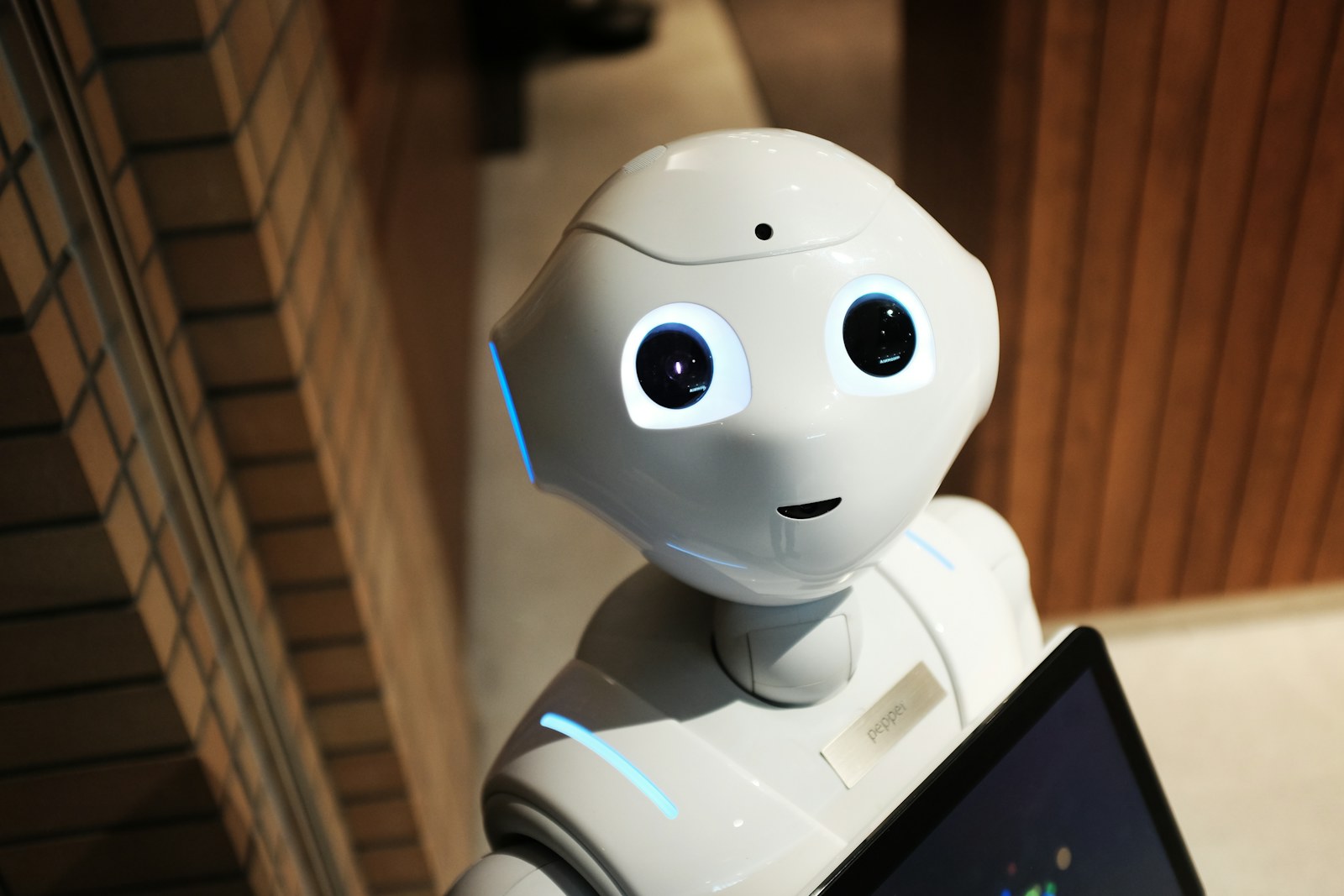
Robotics is also moving into ordinary service environments. In a 2020 announcement, SoftBank Robotics and Bear Robotics introduced Servi for food service and hospitality. The indoor robot was designed for tasks such as bussing, drink delivery and patrol mode, using object detection to move around people and equipment. SoftBank said its broader robot portfolio—Pepper, NAO and Whiz—was being used in areas including retail, tourism, healthcare, education, facilities management and cleaning. [6]
These examples suggest a more realistic definition of a “robot society.” Many systems are specialized, supervised and built around human workers. A restaurant robot may carry dishes so staff can spend more time with customers; a wearable may reduce the effort of lifting; a factory robot may handle a hazardous or highly repetitive step. The likely implication is task redistribution, not a single machine taking over an entire occupation. That is an implication, not a guaranteed outcome: adoption, costs, reliability, privacy and worker acceptance still determine what scales.
What to watch next
For ordinary users, the practical questions are straightforward: Does the device improve independence? Is a person available when it fails? What data does it collect, and who controls it? Students and professionals should watch the less glamorous infrastructure—robot safety standards, accessibility, cybersecurity, maintenance and evidence from care sites. Japan’s policy direction makes clear that successful care technology will be judged by outcomes for people, not by how human-like a machine looks.
Conclusion
Japan’s robotics industry is best understood as a continuum. Its factory expertise supplies the engineering base, while care and service projects test how machines can work with people in homes, hospitals, restaurants and workplaces. The confirmed trend is diversification; the open question is scale. Robots can extend human capability, but responsible deployment will depend on design, training, affordability and human oversight.
Sources and references
- World Robotics 2025 – Industrial Robots: Executive Summary Japan’s 2024 industrial-robot installations, operational stock, global share and sector context.
- Japan’s Car Industry has Highest Robot Installations in Five Years About 13,000 automotive robots installed in Japan in 2024, the 11% annual increase, 2023 automotive robot density and Japan’s role in robot manufacturing.
- Priority Fields in the Use of Robot Technology for Long-term Care Revised Japan’s revised long-term-care technology priorities, 16 items in nine areas, goals and April 2025 implementation timing.
- Wearable Cyborg HAL HAL’s bio-electrical-signal sensing, movement assistance mechanism and medical, workplace, wellbeing and disaster-recovery applications.
- SoftBank Robotics Group and Bear Robotics Announce New Food Service Robot Servi’s documented food-service functions and SoftBank Robotics’ stated application areas for its robot portfolio.
Research current to 2026-11-05; confirmed facts are drawn from the cited official and industry sources, while implications are labelled.
Post your Comment About This Product